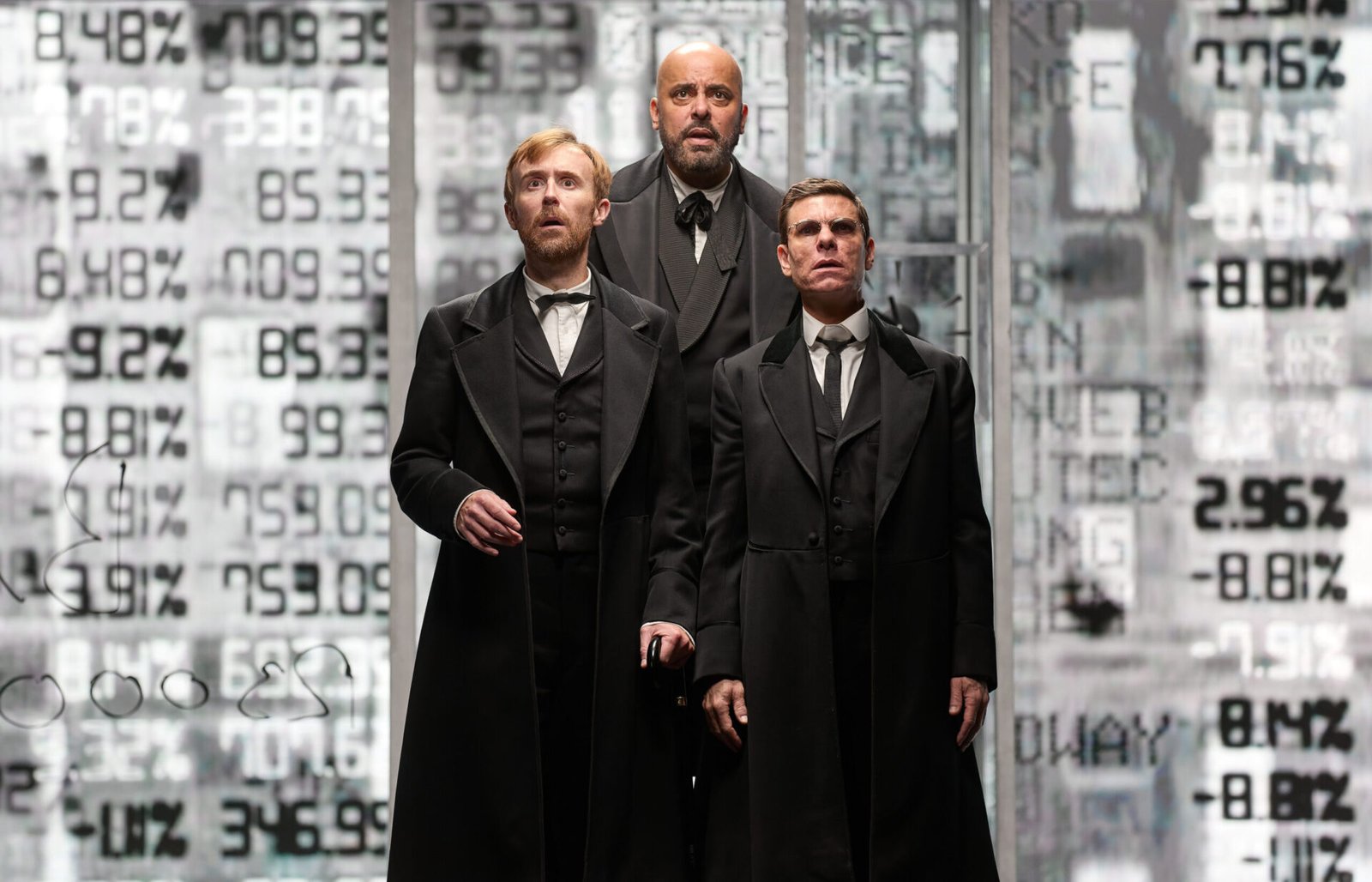
Review: ‘Lehman Trilogy’ a Grand and Immersive Family Epic
The Rise and Fall of the Lehman Brothers
From a 19th- to 20th-century perspective, the Lehman brothers were the shining epitome of the American Dream. Three Bavarian Jewish brothers arrived in the U.S. in the 1840s and — through hard work, keen business sense and ingenuity — built one of the largest financial empires in American history. But today, their company Lehman Brothers — which catastrophically collapsed in bankruptcy in 2008 — is remembered as a textbook case for the pitfalls of unchecked greed, corruption and moral bankruptcy.
The family’s rise and fall is the subject of “The Lehman Trilogy,” a three-act and three-hour-plus saga that opened Saturday at Cygnet Theatre in San Diego. Winner of the 2022 Tony Award for Best Play, the taut, engrossing and beautifully scripted play is evocatively and creatively staged by director Kim Strassburger in an arena-style production in Cygnet’s black-box Dottie Studio Theatre.
Although the audience watches the Lehman Brothers company grow from a barely profitable dry-goods store in pre-Civil War Alabama to a $600 billion finance behemoth on Wall Street, the play doesn’t focus on business. It’s a humor-laced drama about the three brothers and their descendants who built the company and ultimately lost it. Written by Italian playwright Stefano Massini as an epic poem and adapted for the stage by Ben Power, the play’s language is lyrical and gorgeously descriptive.
A Stellar Cast Brings the Story to Life
Bringing the play’s more than 70 characters to life onstage are three of San Diego’s most talented actors: Bruce Turk, Steven Lone and Jacob Caltrider. Besides playing the original Lehman brothers, the three actors also play the men’s wives, sons, in-laws, politicians, business partners, tech bros and even a bawling baby. All three are masterful actors who interact seamlessly and bring urgency, intensity and authenticity to their characters.
Turk imbues Henry — the eldest brother who arrived first in America wearing his “best shoes” — with a courtly and wistful old-world manner. Lone, as the hot-tempered but ingenious middle brother Emanuel, boils with resentment and ambition. And Caltrider’s kind-hearted younger brother Mayer, who calls himself the soft “potato” whose job is to intercede in his siblings’ squabbles, has a gentle and quirky stage presence.
Over the years, the devoutly religious brothers, and their less-devout sons and grandsons, gradually transformed their company from a retail shop into a cotton and coffee broker, to a comodities trader, to an investment bank, to a venture capital firm. After the Lehmans died out, the company’s later owners moved into the unstable sub-prime mortgage market, which led to its demise during the Great Recession.
A Deep Dive into Family and Legacy
As depicted in the play, the Lehman family had its high achievers and its dreamers, its capitalists and its liberals. Although the original brothers faced antisemitism when they arrived, they profited handsomely off the slavery-fueled cotton industry of the mid-1800s. Later generations’ disconnection from their roots is depicted with the steady decline in the traditional mourning observances for older family members, which shrinks from a 7-day shiva for Henry in 1855 to just three minutes of silence for his grandnephew, Bobbie, in 1969.
The 2021 Broadway production of “The Lehman Trilogy” was staged in the 1,200-seat Nederlander Theatre on a large revolving glass cubelike set. Visually, I found that production stunning, but Strassburger’s in-the-round production brings a deeper intimacy and focus to the characters and their stories.
Innovative Set Design and Creative Elements
Scenic designer Matthew Herman created a rectangular center stage with LED panel lighting by Sammy Webster that mimics the flourescent office lights of the past but explodes with color in a surprise dancing-on-the-tables scene. Cardboard office file storage boxes are used as stairs, fences and furniture. Colored dry-erase pens become flowers. Shawls become swaddled infants.
Projection designer Blake McCarty created the digital scroll of financial data that begins and ends the play, along with company’s ever-evolving name signs. Jeanne Reith designed the men’s 19th-century suits and George Ye designed sound.
With two intermissions, “The Lehman Trilogy” runs about 3-1/2 hours. Thanks to its fascinating story and superb acting and direction, it’s never dull. I found it gripping, funny, moving and enlightening.
Details About the Production
‘The Lehman Trilogy’
When:
7 p.m. Wednesdays through Fridays, 1 and 7 p.m. Saturdays, 1 p.m. Sundays. Through April 26
Where:
Cygnet Theatre’s Dottie Studio Theatre, 2880 Roosevelt Road, Arts District Liberty Station
Tickets:
$68 and up
Phone:
619-337-1525
Online:
cygnettheatre.com
